Operational Overview: The Fleet Dilemma
Logistics providers face a binary choice: asset-heavy or asset-light. Modern 3PL demand is non-binary. High-volume, predictable contracts require stability. Rapid e-commerce surges require elasticity. Choosing one model results in inefficiency. Under-utilization during troughs or service failure during peaks are the primary risks.
Owned Fleet: The Control Layer

Maintaining an owned fleet involves high Capital Expenditure (CAPEX). It provides the highest degree of operational control.
Core Attributes
- Brand Consistency: Vehicles and drivers represent the 3PL brand directly.
- Service Level Reliability: Direct management of driver training and schedules ensures high SLA adherence.
- Cost Efficiency at Scale: Fixed costs per unit are lower during periods of high, stable volume.
- Specialized Handling: Necessary for temperature-controlled or high-value cargo requiring specific certifications.
System Constraints
- Low Elasticity: Scaling requires significant lead time for vehicle procurement and driver hiring.
- High Maintenance Overhead: Continuous Operational Expenditure (OPEX) for fuel, insurance, and repairs.
- Idle Asset Risk: Under-utilized vehicles generate negative ROI during off-peak periods.
Crowdsourced Delivery: The Elastic Layer

Crowdsourced delivery taps into the gig economy. It functions as an on-demand resource pool.
Core Attributes
- High Scalability: Capacity can be activated or deactivated within minutes.
- Variable Cost Model: Costs are incurred only when deliveries are performed. No idle asset costs.
- Geographic Reach: Instant access to urban zones without established depot infrastructure.
- Speed: Ideal for same-day or 2-hour delivery windows.
System Constraints
- Variable Quality: Inconsistent driver performance and vehicle condition.
- Brand Fragmentation: No 3PL branding at the final customer touchpoint.
- High Unit Cost: Individual gig-delivery API calls or transactions often carry higher margins than owned fleet operations.
- Management Complexity: Coordinating thousands of independent agents requires high-level technical orchestration.
The Hybrid Model: Strategic Integration

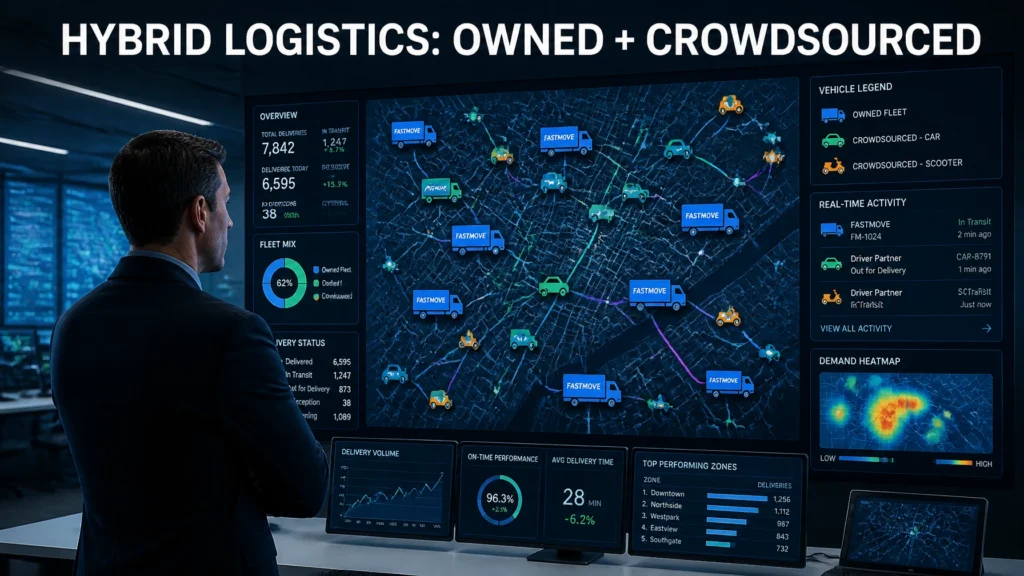
Optimal 3PL performance requires a hybrid model. This approach merges the reliability of owned assets with the flexibility of the gig economy.
Deployment Logic
- Baseline Capacity: Deploy owned fleets for scheduled contract work and high-density routes.
- Peak Overflow: Route excess orders to crowdsourced networks during spikes or seasonal events.
- Low-Density Zones: Use gig drivers for rural or low-volume urban areas where dedicated routes are inefficient.
- Premium Windows: Assign same-day urgent orders to the nearest available crowdsourced agent.
Technical Requirements
- Unified Dispatch: A single logic layer for assigning tasks regardless of fleet type.
- Real-Time Tracking: Consistent visibility across employee-drivers and independent contractors.
- Performance Analytics: Comparative data on cost, speed, and reliability per channel.
Navigating the Logistics API Economy

Modern logistics is driven by the API economy. 3PLs must integrate with external platforms to maintain competitiveness.
Integration Points
- Gig Platforms: APIs for DoorDash, Uber Direct, or Amazon Flex for instant capacity.
- TMS/WMS Sync: Connecting warehouse management systems with external delivery providers.
- Customer Communication: Automated SMS or app notifications triggered by external driver actions.
Failure to integrate leads to data silos. System fragmentation increases operational latency. Ensure your platform supports multi-provider orchestration.
Fleetroot: The Central Command Center
Managing a hybrid model manually is impossible. Data fragmentation leads to ERR_ORCHESTRATION_FAILURE. Fleetroot’s logistics orchestration platform provides the necessary infrastructure.
Functional Capabilities
- Automated Route Planning: Optimizes paths for owned and crowdsourced fleets simultaneously.
- Unified Driver App: Provides a consistent interface for all driver types.
- Dynamic Load Balancing: Automatically shifts workloads between fleets based on real-time capacity and cost.
- End-to-End Visibility: Tracks all deliveries in a single dashboard for the 3PL and the end customer.
Actionable Strategy
- Assess Baseline: Audit 12 months of delivery data to determine permanent fleet requirements.
- Establish API Links: Connect to gig economy networks for on-demand failover.
- Centralize Operations: Move all fleet management to a single orchestration platform.
- Monitor KPIs: Track "Cost Per Stop" and "On-Time Delivery" across both channels.
For comprehensive management of your hybrid fleet, book a demo with Fleetroot. Stop choosing between control and scale. Execute both.