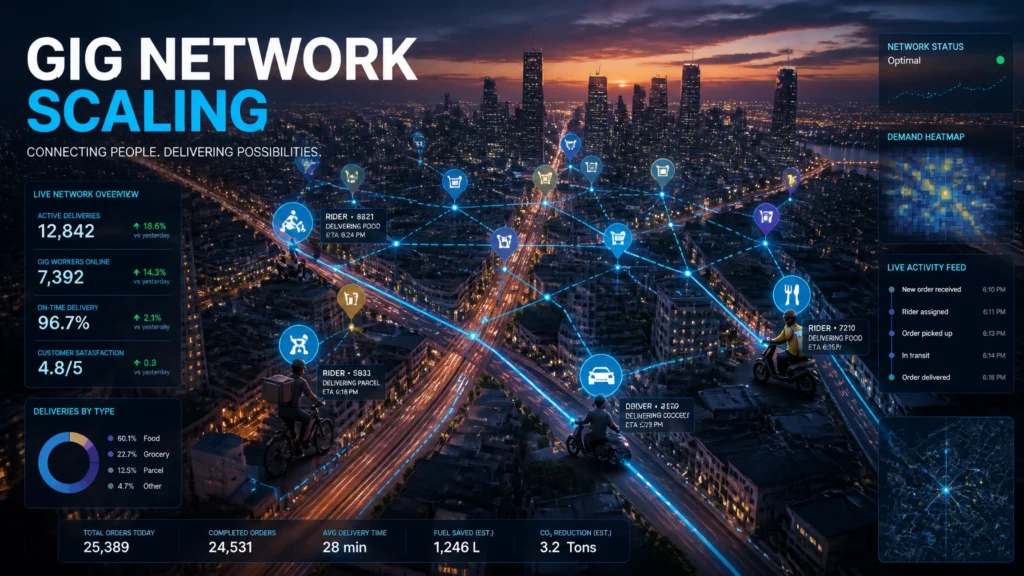
OPERATIONAL STATUS: SCALING THE GIG ECONOMY
Crowdsourced delivery is no longer an edge case. It is a core requirement for 3PLs and retail operations. The shift toward a gig economy delivery model allows for extreme elasticity. Businesses can scale capacity from 10 drivers to 1,000 drivers in response to peak demand. However, scaling human networks with traditional manual processes is impossible.
Manual dispatch fails at 50 drivers. Human error enters the system. SLAs drop. Costs rise. To manage a gig driver network at scale, you must replace human intuition with algorithmic precision. This requires a blend of automated onboarding, AI-driven matching, and real-time telemetry.
The goal is a self-managing system. This article outlines the technical architecture and operational protocols required to orchestrate crowdsourced delivery at scale.
SECURE ONBOARDING: LOGISTICS CYBERSECURITY PROTOCOLS
Onboarding is the first point of failure. A slow process loses drivers to competitors. An insecure process exposes the business to liability. You must treat driver verification as a component of logistics cybersecurity.

AUTOMATED VERIFICATION STEPS
- Identity Document OCR: Use Optical Character Recognition to extract data from driver licenses and national IDs. This prevents manual data entry errors.
- Biometric Liveness Checks: Implement face-matching against ID photos. This ensures the person behind the app is the authorized driver.
- Background Screening APIs: Connect to local law enforcement or third-party databases via API. Automated checks for criminal records and driving history are mandatory.
- Vehicle Compliance: Require high-resolution photos of vehicles and registration documents. Use AI to verify vehicle types (bike, van, car) to match capacity constraints.
SECURITY THRESHOLDS
Systems must trigger an ACCESS_DENIED state if documents are expired or forged. Manual overrides should be minimal. Secure onboarding ensures that your crowdsourced delivery network is built on a foundation of verified, low-risk participants.
THE API ECONOMY: ARCHITECTING THE MATCHING ENGINE
In a gig driver network, the "manager" is an algorithm. This algorithm lives within the logistics API economy. It connects order management systems (OMS) to a distributed pool of independent contractors.

THE MATCHING LOGIC
The engine must evaluate hundreds of variables in milliseconds.
- Proximity: Distance between the driver and the pickup location.
- Capacity: Does the vehicle type match the parcel volume?
- Performance Score: High-performing drivers receive priority for high-value orders.
- Driver Preference: The system respects the driver’s "preferred zones" to reduce rejection rates.
SOLVING THE BIPARTITE MATCHING PROBLEM
Traditional "first-come, first-served" models are inefficient. They lead to "cherry-picking" where drivers only take high-tip or short-distance orders.
- Batching: Combine multiple orders for a single driver. This increases earnings for the driver and lowers cost-per-delivery for the 3PL.
- Auction Models: For difficult orders, use a dynamic price escalation. The system increases the payout until a driver accepts.
- Predictive Dispatch: Use historical data to move drivers toward areas with high predicted demand before the orders even arrive.
Efficient matching is the difference between a profitable connected operation and a logistical bottleneck.
DYNAMIC ROUTING: RECALCULATING REALITY
Gig drivers operate in dynamic urban environments. Traffic, weather, and customer unavailability change conditions every minute. Static routing is a legacy failure.

SYSTEM-LEVEL ROUTING REQUIREMENTS
- Real-time Traffic Ingestion: Routes must update based on live congestion data.
- Dynamic Re-sequencing: If a driver is delayed at stop A, the system must automatically re-calculate the ETAs for stops B, C, and D.
- Geofencing: Trigger "Arrived" statuses automatically when the driver enters a 50-meter radius of the delivery point. This removes the need for manual driver input.
SLA ADHERENCE
For retailers, improving SLA adherence is the primary KPI. Algorithms must prioritize orders with closing time windows. If a gig driver's current route puts an SLA at risk, the system must trigger an alert for manual intervention or automatically re-assign the order to a closer driver.
TELEMETRY AND SCORECARDS: MANAGING WITHOUT MANAGERS
You cannot supervise 500 gig drivers individually. You must use data telemetry to monitor behavior and maintain quality.

CORE METRICS FOR GIG NETWORKS
- Acceptance Rate: How often does the driver say "Yes" to assigned tasks? Low rates indicate a supply-demand mismatch.
- On-Time Delivery (OTD) %: The percentage of deliveries made within the promised window.
- Customer Rating: Direct feedback from the end-receiver.
- Service Time: How long the driver spends at the delivery location. High service times may indicate issues with parking or building access.
ALGORITHMIC DISCIPLINE
Systems should automatically "pause" drivers who consistently fail to meet minimum thresholds. For example, three consecutive late deliveries might trigger a STATUS_SUSPENDED flag. This ensures the network remains high-quality without requiring a massive middle-management layer.
SETTLEMENT SYSTEMS: AUTOMATING THE GIG PAYOUT
Gig drivers work for immediate financial reward. Delayed payments lead to churn. In the gig economy delivery model, the payment system must be as fast as the delivery system.
AUTOMATED SETTLEMENT WORKFLOW
- Proof of Delivery (POD): The payout process begins the moment a digital signature or photo is uploaded.
- Earnings Calculation: The system calculates base pay + distance bonuses + incentives + tips in real-time.
- Instant Payouts: Integrate with Fintech APIs to allow drivers to cash out their earnings daily or even per-trip.
- Dispute Resolution: Create a clear, automated path for drivers to report payment discrepancies. "It's just an accident that was not intentional" is the standard response for minor calculation errors, which are then corrected in the next cycle.
High churn is the biggest cost in crowdsourced logistics. Fast, transparent payments are the most effective retention tool.
FLEETROOT: THE ORCHESTRATION LAYER
Managing a gig driver network is an orchestration challenge. You need a platform that handles the complexity of the "humans vs. algorithms" balance. Fleetroot provides the infrastructure for 3PLs and retailers to deploy these systems at scale.
From Sare3’s transformation of last-mile delivery to managing complex retail networks, Fleetroot acts as the central brain.
WHY FLEETROOT FOR GIG NETWORKS?
- Unified Dashboard: See your owned fleet and your gig network on one map.
- Advanced Dispatch Logic: Automate order assignment based on your custom business rules.
- Driver App: A frictionless interface for gig workers that handles everything from navigation to POD.
- Scale Ready: Our architecture handles thousands of concurrent transactions without latency.
Managing a gig network is an art, but it is powered by a very specific science. If your current system feels like it’s failing, try upgrading your orchestration layer.
Get started with Fleetroot today.