System Overview: The Gig-Economy Transformation
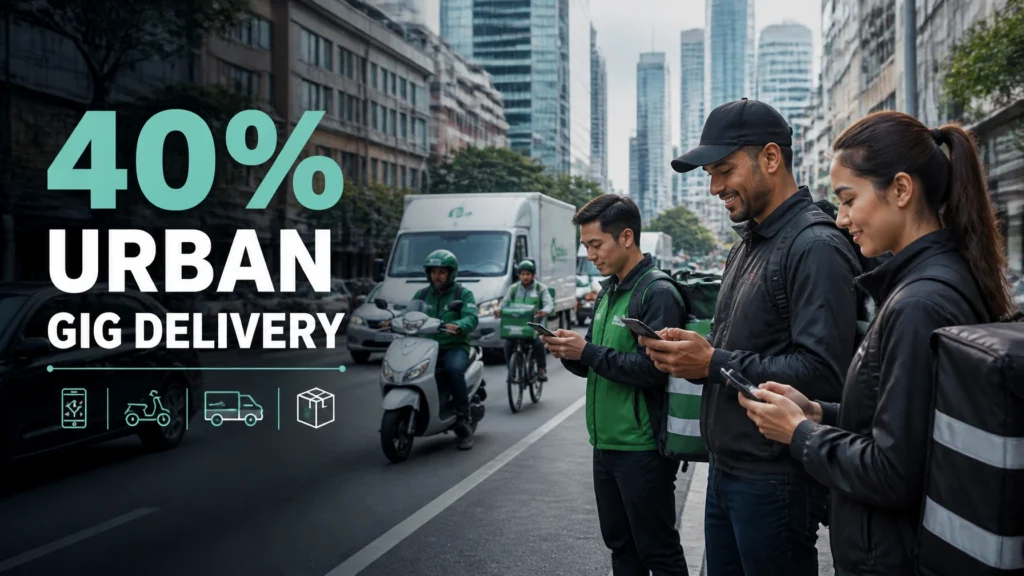
Urban logistics is shifting toward a decentralized, crowdsourced model. Current market projections indicate gig-based networks will handle 40% of all urban last-mile deliveries by late 2026. This transition is driven by the rapid scaling of three primary platforms: Uber Direct, Walmart Spark, and Amazon Flex.
Traditional logistics models rely on fixed assets and scheduled routes. These systems lack the elasticity required for modern on-demand consumer behavior. The gig economy provides a variable-cost alternative. It allows businesses to scale capacity instantly without capital expenditure on vehicles or long-term labor contracts.
For 3PL providers, pharma retailers, and e-commerce giants, the shift is mandatory. Failure to integrate gig capacity results in uncompetitive delivery windows and higher operational overhead.
The Triad: Uber Direct, Walmart Spark, Amazon Flex
Three major entities dominate the crowdsourced delivery landscape. Each utilizes a different strategic approach to capture urban volume.
1. Uber Direct: White-Label Delivery-as-a-Service (DaaS)
Uber Direct functions as an API-first logistics layer. It allows merchants to offer delivery through their own apps while utilizing Uber’s courier network.
- Mechanism: Orders bypass the Uber Eats marketplace. Couriers receive delivery-only requests.
- Market Impact: Provides 3PL-level infrastructure to small and mid-sized retailers without a dedicated fleet.
- Efficiency: Leverages high courier density to maintain low latencies.
2. Walmart Spark: Retailer-Owned Gig Network
Walmart Spark is a captive network designed to support Walmart’s internal volume. It has expanded to serve third-party partners via Walmart GoLocal.
- Mechanism: Drivers deliver from physical retail hubs (Walmart stores).
- Market Impact: Decouples Walmart from traditional carriers like FedEx or UPS for local same-day delivery.
- Scale: Controls a significant portion of US grocery and household goods delivery.
3. Amazon Flex: The Elastic Layer of Amazon Logistics
Amazon Flex supplements the primary DSP (Delivery Service Partner) network. It acts as a surge protector for peak demand.
- Mechanism: Independent contractors use personal vehicles to deliver packages from Amazon stations.
- Market Impact: Enables "Same-Day Delivery" as a standard feature for Prime subscribers.
- Function: Handles the "overflow" that fixed-fleet DSPs cannot process during spikes.

The Logistics API Economy: Technical Infrastructure
The growth of gig delivery is fundamentally a result of the Logistics API Economy. Modern logistics is no longer about owning trucks; it is about managing data streams.
Key Technical Components:
- Webhooks: Real-time status updates from gig platforms to merchant ERPs.
- Dynamic Pricing APIs: Real-time cost calculation based on courier availability and distance.
- Identity & Authentication: Secure courier verification across multi-tenant platforms.
- Route Geo-fencing: Programmatic arrival detection and automated proof of delivery (POD).
Logistics orchestration platforms like Fleetroot utilize these APIs to provide a single pane of glass for mixed fleet operations. By connecting to gig provider endpoints, a business can route an order to an internal driver or a crowdsourced courier based on cost, distance, or SLA priority.
Industry Impact: Pharma, Retail, E-commerce
The impact of gig delivery varies across sectors, requiring different orchestration strategies.
Pharma and Healthcare
Pharma requires high compliance and chain-of-custody tracking. Gig networks were historically avoided due to security concerns.
- Solution: Modern platforms use secure token-based handovers.
- Use Case: Medicina Group of Pharmacies utilized specialized delivery management to improve SLA adherence. View the Medicina Case Study.
- Benefit: Reduced delivery times for urgent prescriptions without increasing fixed fleet size.
Retail and E-commerce
Traditional retailers are transforming into local fulfillment centers.
- The "Store-as-a-Hub" Model: Stores act as micro-warehouses. Gig drivers perform hyper-local delivery.
- Impact: Removes the need for regional distribution center stops.
- Result: Drastic reduction in "last-mile" costs which typically account for 53% of total shipping expenses.

Challenges for Traditional 3PLs
Traditional 3PLs face an efficiency gap when competing with gig-enabled networks.
- Fixed Labor Costs: Traditional drivers are paid hourly or salaried regardless of volume.
- Maintenance Overhead: Vehicle ownership incurs depreciation, insurance, and fuel costs.
- Rigidity: Fixed fleets cannot respond to 300% spikes in holiday demand without 3-month lead times.
To survive, 3PLs must adopt a Hybrid Model. This involves maintaining a core owned fleet for predictable base volume and utilizing gig networks for variability. This strategy requires a connected operation platform to manage cross-platform tracking and billing.
The Bridge: Fleetroot Logistics Orchestration
Fleetroot serves as the orchestration layer between business operations and the gig economy. It eliminates the manual effort of managing multiple delivery apps.
Core Functions of the Orchestration Layer:
- Automated Dispatching: System chooses the most cost-effective carrier (Internal vs. Uber Direct vs. Spark) automatically.
- Unified Tracking: Customers receive a single tracking link regardless of the underlying courier service.
- SLA Management: Monitor performance metrics across different gig providers in one dashboard.
- Carrier Management: Standardized reporting for all third-party and internal drivers.
Implementing an orchestration layer is the only way to scale without adding administrative headcount. For companies looking to optimize their on-demand delivery, getting started with an integrated management system is the first step.

Actionable Implementation Steps
Follow these steps to integrate gig capacity into your logistics stack:
- Audit Fleet Utilization: Identify hours where your internal fleet is at 100% capacity and where it is idle.
- API Integration: Connect your WMS/ERP to a logistics orchestration platform like Fleetroot.
- Define Routing Logic: Set rules (e.g., "If order is < 5km and weight is < 2kg, send to Uber Direct").
- Onboard Gig Partners: Activate accounts with Uber Direct or Walmart GoLocal.
- Monitor and Adjust: Use real-time analytics to shift volume based on carrier performance and cost-per-delivery.
Conclusion: Optimization Complete.
The expansion of Uber Direct, Walmart Spark, and Amazon Flex is not just a trend; it is a structural change. Urban logistics is becoming a utility accessible via API. Businesses that manage this utility through centralized orchestration will capture the 40% urban market share. Those that rely on legacy fixed-fleet models will face obsolescence due to cost-inefficiency.
Shift to an elastic delivery model. Contact Fleetroot sales to integrate your logistics network.