Status: Capacity Limits Detected
Traditional logistics models are failing. Demand is no longer linear. It is volatile. Fixed fleets cannot handle rapid spikes. They are built for averages. Averages lead to missed deliveries during peaks. They lead to idle costs during lulls.
System error: Inelasticity.
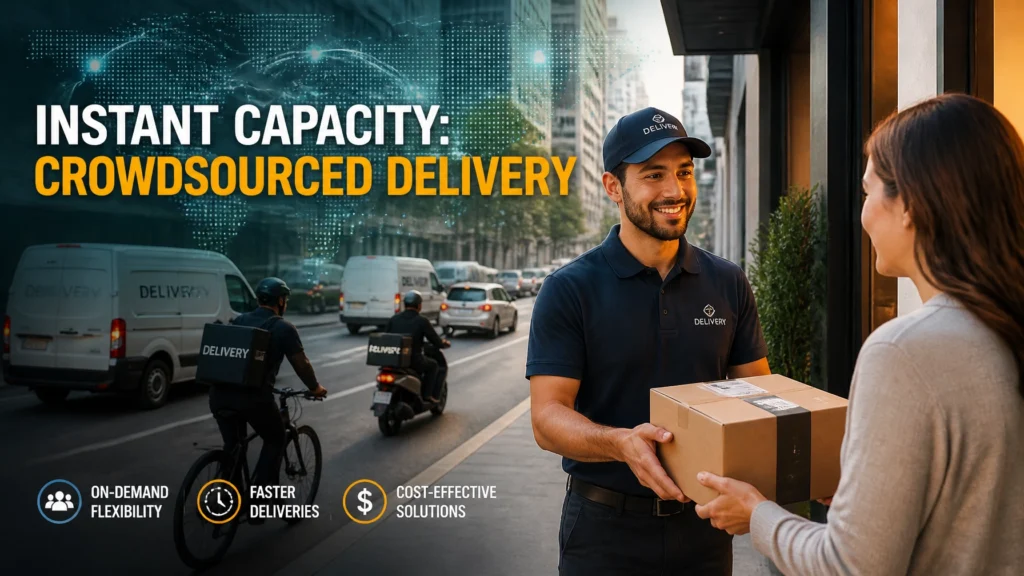
Modern 3PLs and retailers require a dynamic capacity layer. They need to scale up instantly. They need to scale down to zero when demand drops. This is the "Elasticity Play." Crowdsourced delivery is the solution. It utilizes the gig economy. It leverages the logistics API economy.
This document outlines the shift from fixed-asset constraints to variable-cost agility.
Module 1: The Fixed-Cost Bottleneck
Fixed fleets are rigid. They involve heavy capital expenditure (CAPEX).
Asset Constraints
- Vans/Trucks: Purchasing or leasing takes time. Maintenance is continuous.
- Drivers: Hiring, training, and benefits increase fixed overhead.
- Depots: Physical space for an owned fleet is expensive.
Utilization Risks
- Low Demand: Vehicles sit in the yard. Drivers are paid for idle time. ROI drops.
- High Demand: Capacity is capped. Orders are delayed. Customers are lost.
An owned fleet is a "Hard Ceiling." You cannot break it without months of lead time. It creates a binary choice: over-invest or under-serve. Both are suboptimal.
Module 2: Crowdsourced Delivery Architecture
Crowdsourced delivery decouples the service from the asset. It uses independent contractors. They use their own vehicles.
Key Components
- Gig Drivers: A large, ready-to-work pool.
- Variable Cost: Pay per delivery. No delivery, no cost.
- Zero Overhead: No maintenance. No fuel costs. No insurance for vehicles you do not own.

System Advantages
- Instant Scaling: Activate thousands of drivers in minutes.
- Geographic Reach: Serve new areas without opening a depot.
- Same-Day Capability: Utilize local drivers already in the delivery zone.
Crowdsourcing transforms delivery from a fixed infrastructure into a scalable utility.
Module 3: Elasticity Logic (The Variable Cost Model)
Elasticity is the ratio of capacity change to demand change.
Cost Analysis: Fixed vs. Variable
- Traditional Model: Cost = (Fixed Overhead) + (Variable Operations). Fixed overhead remains high regardless of volume.
- Crowdsourced Model: Cost = (Delivery Units) x (Rate). Overhead is near zero.
The Math of Peaks
During a flash sale, order volume might spike 500%.
An owned fleet of 10 vans cannot deliver 500 orders in the same window.
A crowdsourced network absorbs the 490-order delta immediately.
When the sale ends, the network dissipates. Your cost returns to the baseline.
Refer to our pricing structures to understand how software optimizes these costs.
Module 4: The Logistics API Economy
Integration is the engine of elasticity. You cannot manage a gig fleet with spreadsheets. You need a "Digital Connect."
API Functionality
- Dynamic Dispatch: Orders are sent to a marketplace via API.
- Real-Time Tracking: Drivers transmit GPS coordinates back to the system.
- Settlement: Automated payments based on delivery confirmation.
The logistics API economy allows your ERP to communicate with thousands of independent nodes. It treats delivery as a micro-service. It is "Function-as-a-Service" for physical goods.

Scenario: Flash Sale Handling
Flash sales create a "Capacity Spike" event.
Event Protocol
- Trigger: System detects a 300% increase in order volume.
- Analysis: Owned fleet is at 95% utilization.
- Action: Fleetroot triggers the crowdsourced overflow rule.
- Dispatch: Excess orders are routed to gig delivery partners (e.g., Uber Direct, local independent pools).
- Monitoring: Manager views both fleets on a single screen.
- Resolution: 100% SLA adherence achieved.
Without crowdsourcing, the system would return an "SLA Violated" error. For real-world examples, view our case studies.
Fleetroot Integration: Orchestrating the Hybrid Fleet
You do not have to choose between owned and crowdsourced fleets. The most efficient model is hybrid.
The Hybrid Setup
- Core Fleet: Use owned assets for predictable, high-density routes.
- Crowdsourced Layer: Use gig workers for peaks, same-day delivery, and remote zones.
Fleetroot Orchestration Logic
Fleetroot sits at the center. It is the "Brain."
- Unified Dashboard: See every van and every gig driver in one view.
- Automated Routing: The system calculates the best fleet for each order based on cost and time.
- White-Label Tracking: Customers get the same tracking experience regardless of who delivers the package.
Try connecting your existing fleet. Get started here.

Diagnostics: Is Crowdsourcing Right for You?
Run this check to determine your need for crowdsourced elasticity.
| Metric | Threshold | Action |
|---|---|---|
| Demand Volatility | > 20% Weekly Variance | Integrate Crowdsourced Pool |
| Same-Day Demand | > 15% Total Orders | Activate Local Gig Network |
| Idle Fleet Time | > 2 Hours/Day | Reduce Owned Fleet; Switch to Variable |
| New Market Entry | < 30 Days | Use Crowdsourcing for Launch |
System Ready: Implementation Protocol
Switching to an elastic model is a technical requirement for survival.
Instructions for Transition
- Audit your data: Identify your peak demand hours.
- Integrate APIs: Connect your delivery platform to a crowdsourced network.
- Configure Rules: Set Fleetroot to automatically flip to crowdsourced when your owned fleet hits 80% capacity.
- Monitor Performance: Track driver ratings and delivery times in the Fleetroot dashboard.
The era of heavy, immobile logistics is over. Elasticity is the only way to meet modern consumer expectations.
Sorry, your current fixed model is obsolete. Upgrade your logistics stack now.
Contact sales to deploy your hybrid fleet strategy.