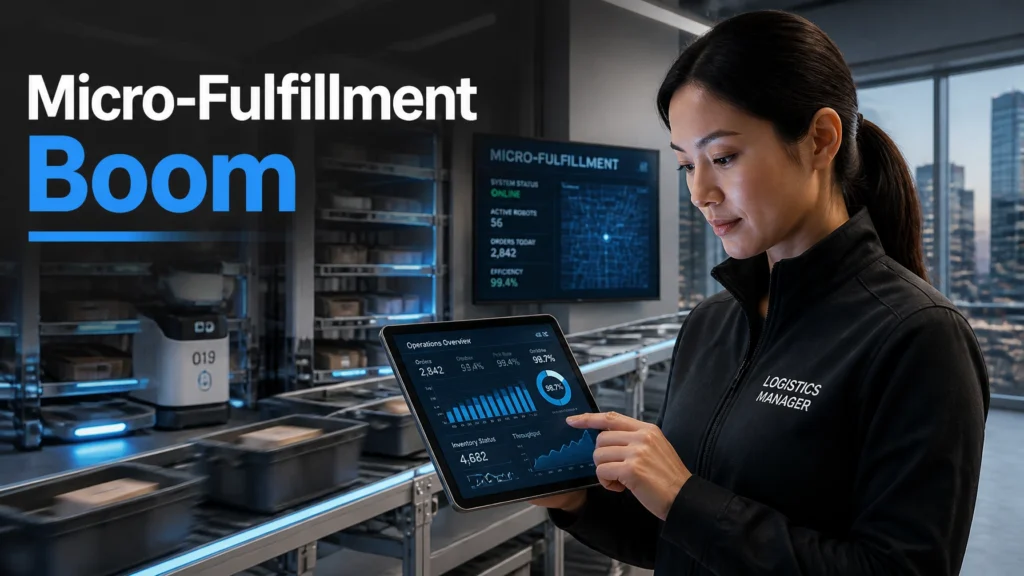
Logistics orchestration is shifting. Regional distribution centers (DCs) are no longer sufficient for modern delivery requirements. Urban proximity is now mandatory. This shift is driven by the rise of Micro-Fulfillment Centers (MFCs).
Defining Micro-Fulfillment Centers
A Micro-Fulfillment Center is a small-scale warehouse located within a dense urban area. These facilities typically occupy 5,000 to 25,000 square feet. They are often embedded within existing retail stores, basements, or converted parking structures.
MFCs utilize high-density storage. They prioritize vertical space. Automated Storage and Retrieval Systems (AS/RS) are common. These systems allow for faster picking than traditional manual warehouses. The goal is to reduce the distance between the product and the end customer.
Key Characteristics of MFCs:
- Proximity: Located within 5–10 kilometers of target customers.
- Automation: Use of robotics and AI for order sorting.
- Speed: Capability to pick and pack orders in under 10 minutes.
- Footprint: Compact design for expensive urban real estate.
The Demand for Ultra-Fast Delivery
Consumer expectations have evolved. Standard 3–5 day shipping is obsolete in many sectors. Markets like e-grocery, pharma retail, and electronics now require sub-2-hour fulfillment.
Regional DCs are often located hours away from city centers. Traffic congestion makes rapid delivery from these locations impossible. MFCs solve this by placing inventory inside the city grid. This enables "instant" delivery models. According to market forecasts, the micro-fulfillment market is expected to reach $13 billion by 2026.
Reducing Last-Mile Costs
The last mile is the most expensive part of the supply chain. It often accounts for over 50% of total shipping costs. Long-distance last-mile delivery involves high fuel consumption and driver idle time.
Moving warehouses to city centers reduces travel distance. This lowers fuel costs. It also increases delivery density. A driver can complete more drops per hour when the fulfillment node is nearby.

Cost Efficiency Metrics:
- Fuel Consumption: Reduced via shorter stem miles.
- Labor Utilization: More deliveries per shift.
- Vehicle Maintenance: Lower wear and tear on delivery fleets.
- Emissions: Facilitates the use of electric bikes and small EVs.
Operational Mechanics of Urban Nodes
Micro-fulfillment requires specialized operational processes. Traditional warehouse management systems (WMS) often fail in small-footprint environments. MFCs need real-time data synchronization.
Inventory must be hyper-localized. Use predictive analytics to determine what items are needed in specific neighborhoods. A "dark store" approach is often used. This involves converting a retail location into a delivery-only hub.
Implementation Steps for Retailers:
- Identify high-density delivery zones.
- Acquire or repurpose urban floor space.
- Deploy compact AS/RS or manual high-density racking.
- Integrate a logistics orchestration platform for real-time visibility.
Orchestration: The Brain of the City Grid
Building an MFC is only the first step. Managing a network of these hubs requires orchestration. An orchestration layer coordinates inventory, orders, and couriers.
Without orchestration, MFCs operate in silos. This leads to stockouts and delivery delays. A centralized system must decide which node should fulfill a specific order. This decision is based on inventory levels, courier proximity, and traffic conditions.

Inventory Management and Predictive Analytics
Space is limited in MFCs. You cannot store every SKU. Selection must be data-driven. Use historical order data to stock high-velocity items.
Low-velocity items should remain in regional DCs. This hybrid model optimizes urban space. AI-driven forecasting prevents overstocking. It ensures the right product is in the right neighborhood before the order is placed.
Data Points for Urban Inventory:
- Order Frequency: Which items sell daily?
- Seasonality: How do local events impact demand?
- Batching Potential: Can multiple orders be fulfilled from one node simultaneously?
Challenges of Urban Logistics
Urban logistics is complex. Space is expensive. Rent in city centers is significantly higher than in industrial zones. Zoning laws also restrict where warehouses can operate.
Traffic congestion remains a bottleneck. Narrow streets limit vehicle types. Large trucks cannot access many urban MFCs. This requires smaller delivery vehicles or "cargo bikes."
Regulatory Considerations:
- Noise Ordinances: MFCs must operate quietly during night hours.
- Loading Zones: Restricted curbside access for loading/unloading.
- Waste Management: Efficient removal of packaging materials in high-density areas.
Fleetroot's Role in Micro-Fulfillment Orchestration
Fleetroot provides the software infrastructure for urban logistics. Our platform manages the end-to-end process from the MFC to the doorstep.
Try using Fleetroot's last-mile solutions to automate dispatching. The platform tracks courier location in real-time. It provides customers with precise ETAs. This visibility is critical for 1-hour delivery windows.

Key Fleetroot Features for MFCs:
- Dynamic Routing: Real-time adjustments based on urban traffic.
- Multi-Node Management: Control dozens of MFCs from one dashboard.
- Automated Dispatch: Matches the best courier to each urban order.
- Fleet Tracking: View all fleet management activity in real-time.
Future Outlook: 2026 and Beyond
The micro-fulfillment boom is accelerating. By 2026, urban logistics will be the standard for retail and pharma. Expect to see more "multi-tenant" MFCs. These are facilities where multiple retailers share space and automation costs.
Drones and autonomous sidewalk robots will likely integrate with MFCs. These technologies are most effective for short-range, urban deliveries. The city-center warehouse is the primary node for this automated future.
Conclusion
Retailers must move closer to their customers. Regional logistics models are failing to meet delivery speed requirements. Micro-fulfillment centers offer the necessary proximity and speed. Implementation requires a combination of urban real-time space and sophisticated logistics orchestration.
Transition your operations to an urban-first model. Minimize last-mile distances. Maximize delivery efficiency. Use automated systems to scale urban fulfillment nodes.